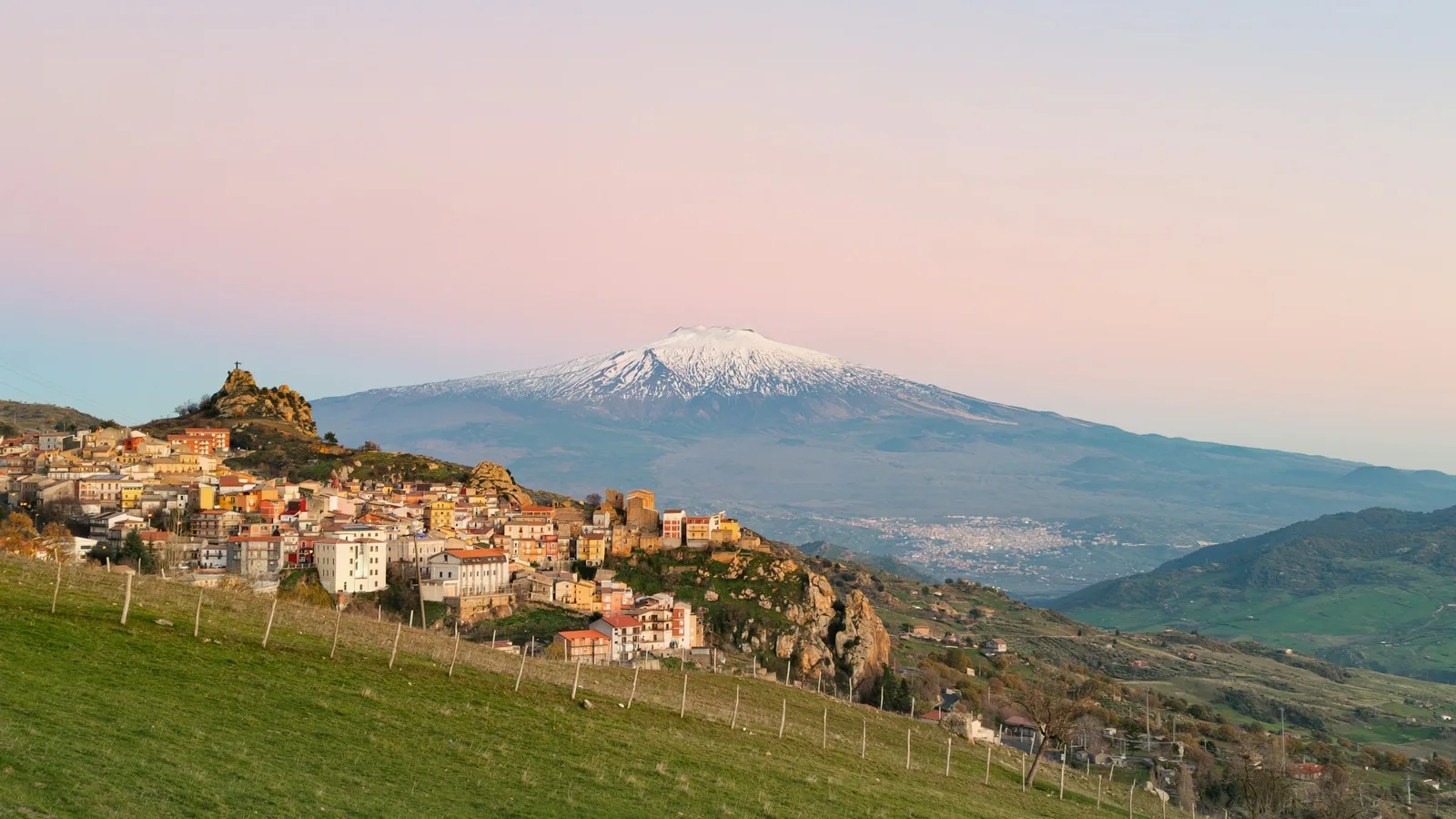
Etna Contrade: The Geography Behind Sicily's Volcanic Wines
Mount Etna's DOC rules list 133 named contrade around the volcano, often compared to Burgundy's climats. Here is how four of them show up in the glass.
The word 'contrada' has no direct English translation. It is not a commune. It is not an appellation. It is not a single vineyard. Across most of Italy it means roughly 'neighbourhood' or 'district', and depending on the region it carries anywhere between real legal weight and pure folklore. On Mount Etna it means something very specific: a named geographic zone, defined by altitude, exposure and the particular volcanic material underneath the vines. The Etna DOC production rules list 133 of them, spread around the volcano, with a large share on the northern slope around Castiglione di Sicilia and Randazzo. They are often compared to the climats of Burgundy, and the comparison holds better than most.
Why the volcano organises itself this way
Etna is old. Its eruptive history goes back roughly half a million years, and at least 2,700 years of that activity has been written down, one of the longest historical records of any volcano. The 1669 eruption, the one that reached Catania, is simply the most famous episode of a story that never really stopped. Each eruption leaves a layer of lava, ash, lapilli or scoria on the slopes, and those layers differ in age, texture and weathering. The vineyards on Etna are not planted on 'volcanic soil' in a generic sense: they sit on the debris of particular flows, some centuries old, some far older, and growers will tell you that the wine changes with them.
The old vines survived here for a second reason: phylloxera, the louse that devastated European vineyards in the second half of the nineteenth century, struggles in loose, sandy volcanic soils. Some of the oldest working Nerello Mascalese vines on Etna, grown on their own roots rather than grafted onto American rootstock, are around a century old and sit on the contrade of the northern slope.
Four contrade that explain the appellation
The best way to understand what contrada means is to taste across a few of them, on the same grape, in a single afternoon. Four that producers on the northern slope frequently name on their labels:
Guardiola (Castiglione di Sicilia, north slope, roughly 800–1,000 m). One of the highest contrade in the appellation, at the upper edge of the vineyard zone and bordering the lava flow of the 1947 eruption. Lean soils of sand and basaltic gravel. The wines tend to be tense and mineral, with the high-altitude acidity that lets them age.
Barbabecchi (near Solicchiata, Castiglione di Sicilia, north slope, roughly 900–1,000 m). Another high contrada, known for very old vines, some planted around a century ago. Lighter in colour, perfumed, with a clear red-fruit profile.
Santo Spirito (Castiglione di Sicilia, north slope, roughly 650–800 m). The forest-floor contrada. Deeper and darker, with dried herb and undergrowth notes. Old terraced vines sit alongside newer plantings.
Feudo di Mezzo (Castiglione di Sicilia, north slope, roughly 600–700 m). The lowest of the four. Much of it lies on older, weathered lava, while one parcel at its upper edge stands on soils from the 1676 eruption. Riper fruit, broader in the mouth.
The point is not that one contrada is 'better' than another. The point is that they are different, and that the difference is legible in the glass with even mild attention. A wine from Guardiola and a wine from Santo Spirito, same grape, same vintage, same winemaker if that is possible, are noticeably different wines. That is a rare condition in international viticulture: recognisable expression below the level of the village.
What to ask when you visit
Most tourist-facing winery visits on Etna present a single estate wine against a single piece of land, and the contrada frame disappears. That is a missed opportunity. What you want is either a vertical of one contrada across three vintages, or a horizontal across two contrade in the same vintage. Either one will teach you more about Etna in forty-five minutes than a generic tasting of five estate wines will teach you in two hours.
A day among the contrade is the natural shape of this comparison. The northern slope is an easy day out from Taormina, and with GIORIZZ's hourly chauffeur service your chauffeur takes you from one estate to the next while you taste; the estates and the order are yours to choose. If you would rather have the day put together for you, a private wine day can be arranged on request through our tours page.
A note on DOC rules
The Etna DOC, established in 1968, was the first wine appellation recognised in Sicily. The 2011 revision of its production rules identified, mapped and listed the 133 contrade, which may now appear on the label as an additional geographic mention. According to IRVO, the Sicilian regional institute for wine and olive oil, only a minority of them are actually claimed by producers. Not every producer bothers to declare the contrada even when they could: sometimes because the wine crosses two contrade, sometimes because the producer prefers the name of the estate to the name of the land. This is worth knowing when you read an Etna Rosso back label in a wine shop: the absence of a contrada name does not necessarily mean a mixed-source blend; it may be an editorial choice.
The appellation is also in the middle of a change of status. The producers' consortium has been working to upgrade Etna from DOC to DOCG, with the 2026 vintage as the stated target; check the current position before relying on either label.
The wine revival on Etna has been under way for about two decades, and it is still moving. What is consistent is that the contrade exist, and that they shape the wines. Everything else is debate.
Travelling with GIORIZZ
Most visitors reach the northern slope from Catania Airport or from a base in Taormina. Eruptions occasionally affect flights, and our guide to Etna ash and Catania Airport closures explains what that means in practice. Tell us which estates you want to see and we will plan the day around them. Request a quote.
Stay Informed
Receive destination guides, travel insights, and curated stories from the world of premium mobility.