Reading the Muqarnas Ceiling of Palermo's Palatine Chapel
Above the mosaics of Palermo's Palatine Chapel is the oldest surviving wooden muqarnas ceiling. How to read it, who probably painted it, and how to see it.
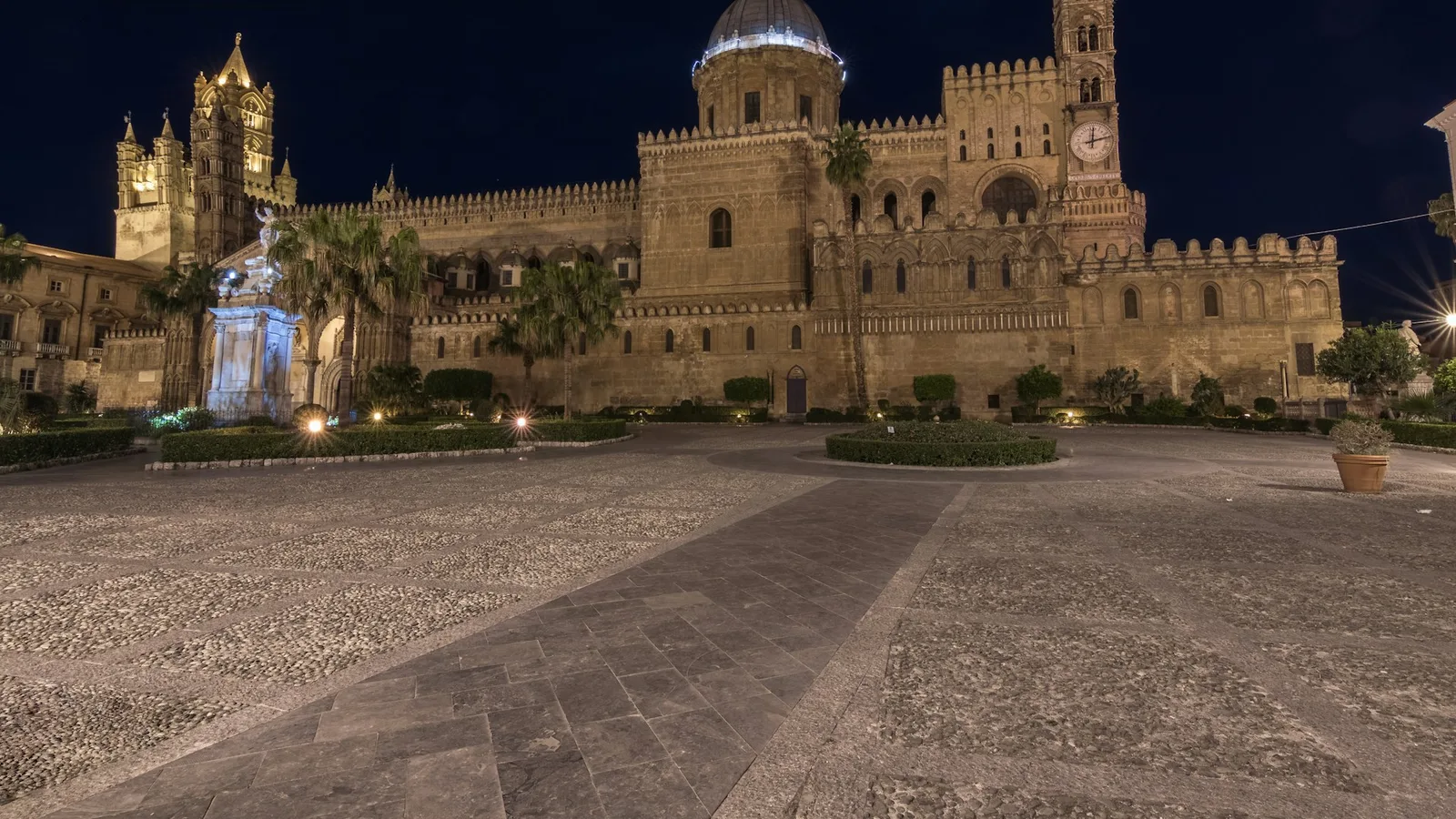
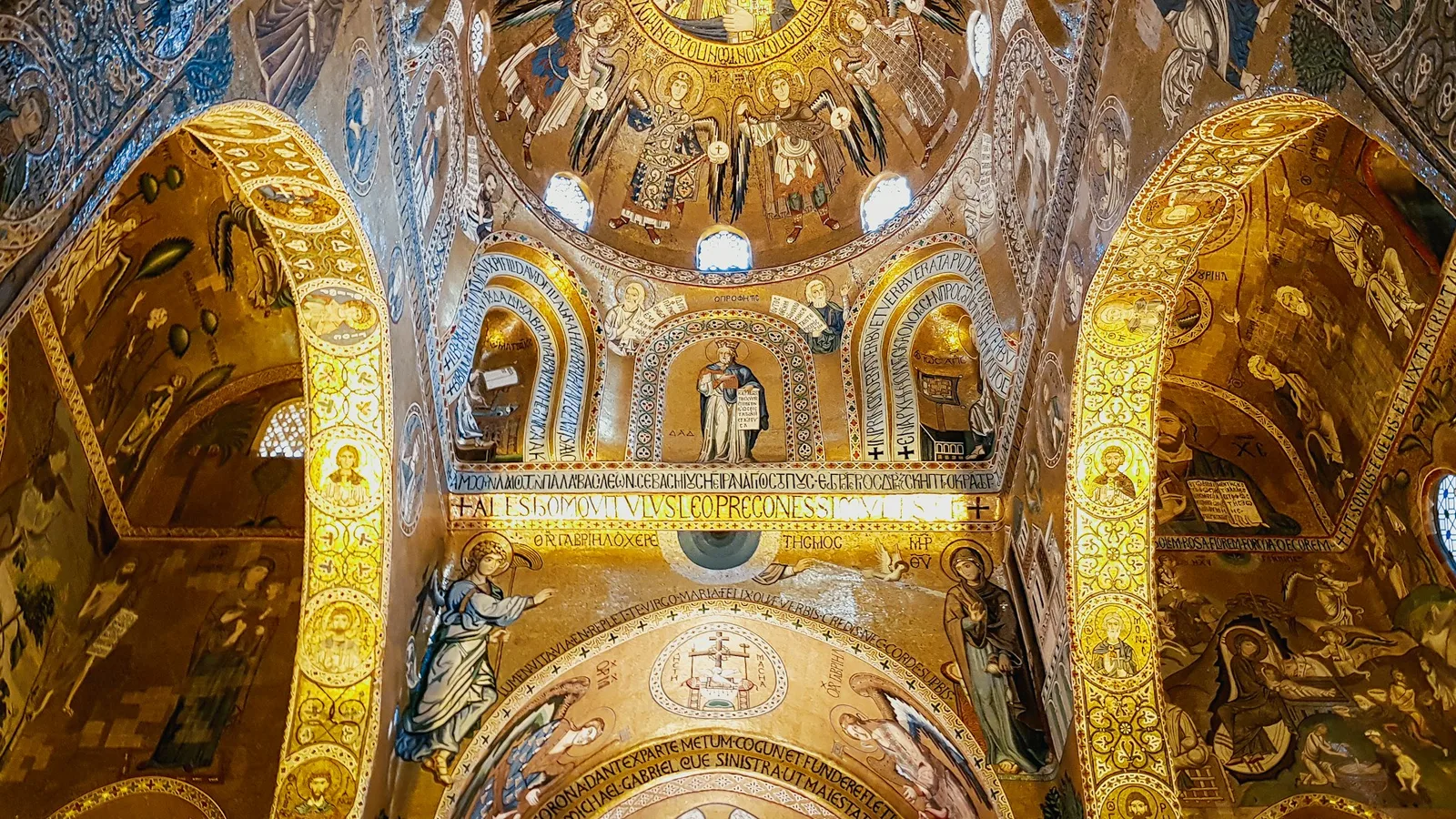
Most visitors to the Cappella Palatina, inside the Royal Palace in Palermo, spend their time looking at the mosaics. Understandably: the gold Byzantine cycle that wraps the walls, the dome and the apses is the first thing the eye finds. But the wooden ceiling above the nave, carved, assembled and painted in the twelfth century, deserves at least as much of your time, and it rewards a slower look than most people give it.
What a muqarnas is
A muqarnas is a vault built from small, stalactite-like cells arranged in tiers, so that a flat ceiling seems to dissolve into a honeycomb. It developed in the Islamic world from around the tenth and eleventh centuries and spread across Iran, Iraq, Egypt and North Africa, used to turn corners, fill domes and dress the ceilings of palaces and mosques.
The ceiling of the Palatine Chapel is the earliest surviving wooden muqarnas ceiling. It is also, in the words of the historian Jeremy Johns, the only more or less complete painted wooden palace ceiling to survive from the Islamic world before the thirteenth century. That it covers the nave of a Christian royal chapel is the whole point.
How it got to Palermo
The palace was not new when Roger II became king. Its first nucleus was a fortified building of the Arab period, and the Norman rulers rebuilt and extended it. Roger was crowned on Christmas Day 1130, and the chapel followed in the early 1130s: a foundation charter of 1132 is the date usually cited. The chapel was dedicated in 1140, and a mosaic inscription dated to 1143 shows that the building was complete by then while its decoration was still in progress. Parts of the mosaic programme were finished only under his successors.
Roger's kingdom was run in three languages, and royal documents were issued in Greek, Latin and Arabic. The chapel reflects the same court: Byzantine mosaicists for the walls, a Latin liturgy at the altar, and an Islamic ceiling overhead.
Who made the ceiling is still debated. The most widely accepted view, argued by Johns, is that it was painted by Muslim artists trained in Fatimid Egypt, the Ismaili Shiite caliphate that ruled from Cairo, who came to Palermo around 1140. Other scholars have proposed painters working in an Iranian tradition, or craftsmen already active in Sicily. The evidence for the Egyptian connection is stylistic, which is why the careful phrasing is 'probably'.
What the ceiling shows
Look up and the structure resolves into a sequence of large eight-pointed stars set between tiers of muqarnas cells. Inside the stars and across the cells are hundreds of small painted scenes: feasting figures, musicians, dancers, wrestlers, horsemen, hunting scenes, lions, elephants and other animals, and a good deal of geometric and vegetal ornament. Around the stars run Arabic inscriptions in Kufic script, invocations of good fortune, prosperity and health for the ruler.
The subject is the life of a court: feasting, music, the hunt. Nothing on the ceiling is a Christian scene. This is the vocabulary of an Islamic princely hall, placed by a Christian king above a space in which he also appeared in state, on the raised throne platform at the west end.
What it is telling us
Historians usually read the ceiling as a statement about kingship rather than decoration chosen for its beauty alone. Roger ruled a kingdom with Greek, Latin and Arabic-speaking subjects, and he borrowed the visual language of the most prestigious courts of the Mediterranean, Constantinople and Cairo among them, to present himself as their equal. The inscriptions wish the ruler well in terms his Arabic-speaking officials and visitors would have recognised at once.
This is why the period is studied as its own category. It is not simply 'Normans who absorbed Islamic influence', nor 'Muslims who survived Norman rule'. For the span of the Norman kingdom, from 1130 to 1194, several traditions worked inside the same court and, in this chapel, under the same roof.
How to look at it
A few practical notes:
- Give your eyes a minute. Coming in from the courtyard, the chapel can feel dim; the ceiling details appear once you have adjusted.
- Start from the centre of the nave and look straight up to read the overall pattern of stars and tiers, then move along the side walls to see the painted cells at an angle.
- Bring a pair of compact binoculars, or use your phone's zoom. Many of the figures are small and high, and the detail is in the faces, instruments and animals.
- Do not neglect the aisles. Their ceilings are painted too, in a different and simpler scheme.
- If you can, avoid the busiest hours of the day: a less crowded room makes it much easier to stand still and look up.
The chapel is visited as part of the Royal Palace, managed by the Fondazione Federico II. Opening hours vary by day of the week, not every area of the palace is open every day, and the chapel can close in full or in part at short notice for religious or institutional reasons, or for restoration works. Check the current timetable and book tickets on the Foundation's official website before you go.
The three-cathedral programme
The Cappella Palatina belongs with two other royal commissions: the cathedral of Cefalù, begun by Roger II in 1131, and the cathedral of Monreale, begun by William II in 1174. In 2015 UNESCO inscribed all three as part of the World Heritage site 'Arab-Norman Palermo and the Cathedral Churches of Cefalù and Monreale'. Seeing them in sequence over one or two days is the clearest way to understand what the ceiling was part of. A private Arab-Norman day can be arranged on request through our tours page, or you can plan it yourself with the hourly chauffeur service and set the order as you like.
Travelling with GIORIZZ
Most visitors arrive through Palermo Airport and base themselves in Palermo for this part of the island. If you would like help with tickets, timings or a guide for the day, our concierge can help with the arrangements. Request a quote.
Stay Informed
Receive destination guides, travel insights, and curated stories from the world of premium mobility.