Half past eight in Catania, and the volcano already closes the end of the street. Via Etnea was laid out almost in line with the mountain when the city was rebuilt after the eruption of 1669 and the earthquake of 1693, and it is paved with Etna's own lava stone. UNESCO, which added Mount Etna to its World Heritage List in 2013, calls it the most active stratovolcano in the world and the highest mountain on any island of the Mediterranean. This private day joins the volcano and Taormina, the old town above the Ionian Sea, in one loop from Catania, made for a stay in the city or a day ashore from a ship. Your chauffeur takes the mountain bends and keeps the time, and the landscape is yours.
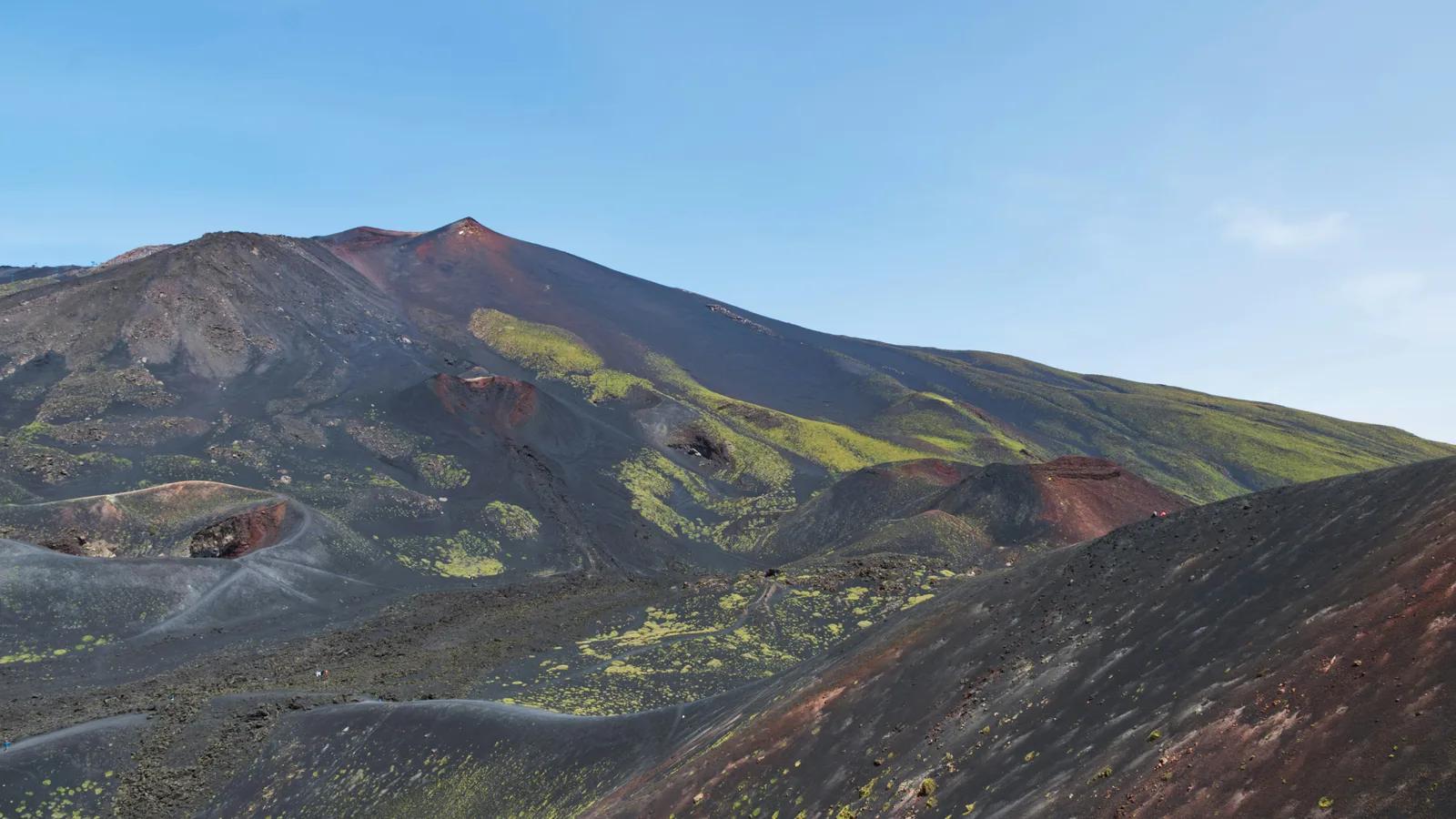
The road leaves the city to the north and climbs through Nicolosi. Just above the town stand the Monti Rossi, two cones raised by the eruption of 1669, whose lava reached the city you have just left and closed around its Castello Ursino. Higher up, the SP92 runs over the black flows of 1983, an eruption that broke the road in many places, and rises to the Rifugio Sapienza, where the car stops on the forecourt at about 1,910 metres. The Silvestri craters rise right beside it, cones opened in 1892 and named after the volcanologist Orazio Silvestri. The lower one is an easy walk, the upper one a steeper climb, and you follow their rims while your chauffeur waits with the car. The cable car toward the Montagnola, at about 2,500 metres, leaves from the same forecourt, and off-road vehicles carry on above it. Both are run by others and paid for on site, and the upper slopes open or close with the volcano and with the orders of the local authorities.
The way down follows the SP92 east to Zafferana Etnea, a town known for its honey, where the Chiesa Madre rises white above a flight of dark lava steps. In 1992, after months of eruption, the lava halted within a kilometre of the town. After a coffee in the square, the road runs down to the coast and north to Taormina, and your chauffeur sets you down at the nearest permitted point to Porta Messina, the gate where Corso Umberto begins. Closed to traffic, the street crosses the old town to Porta Catania, and halfway along it opens onto Piazza IX Aprile, named after a day of 1860: a terrace over the Ionian Sea, framed by the church of San Giuseppe, the former church of Sant'Agostino and the clock tower. Lunch is yours to choose, and you book and pay for it directly.
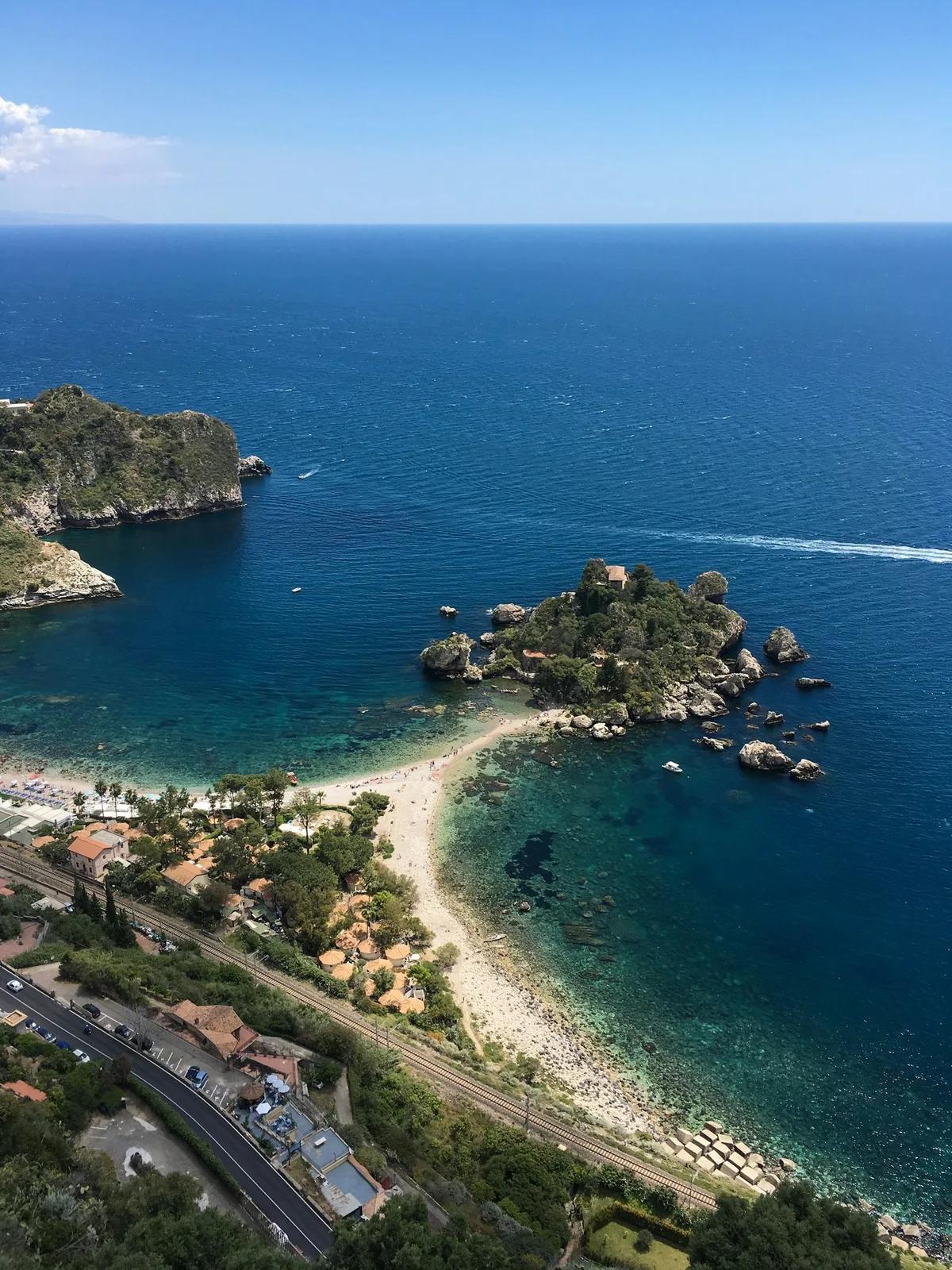
In the afternoon you walk to the Teatro Antico, built by the Greeks in the third century BC and rebuilt under Roman rule. After the theatre of Syracuse it is the largest of Greek origin in Sicily, carved into the rock with Etna and the sea in view. The theatre, Corso Umberto, Piazza IX Aprile and Isola Bella all appear in the second season of The White Lotus, broadcast in 2022. Your ticket for the theatre is bought on site. On the way out, your chauffeur stops at the nearest permitted point above Isola Bella, the small island joined to the shore by a narrow strip of pebbles. Florence Trevelyan bought it in 1890, and it has been a nature reserve since 1998. The motorway then brings you back to Catania in about an hour, or to another address.
The day is private from pickup to return, with no other guests and no fixed schedule: the times of the itinerary are a plan rather than a timetable, and you change them with your chauffeur along the way. It is a day of two climates: the craters are high and exposed, cooler than the coast even in summer, with a wind that can be strong, while by lunchtime you are walking above the sea. Layers cover both, with a windproof jacket and closed shoes for the volcanic ground. Nobody can promise the view, the weather or the volcano's activity, and we do not: what we take care of is the transport.