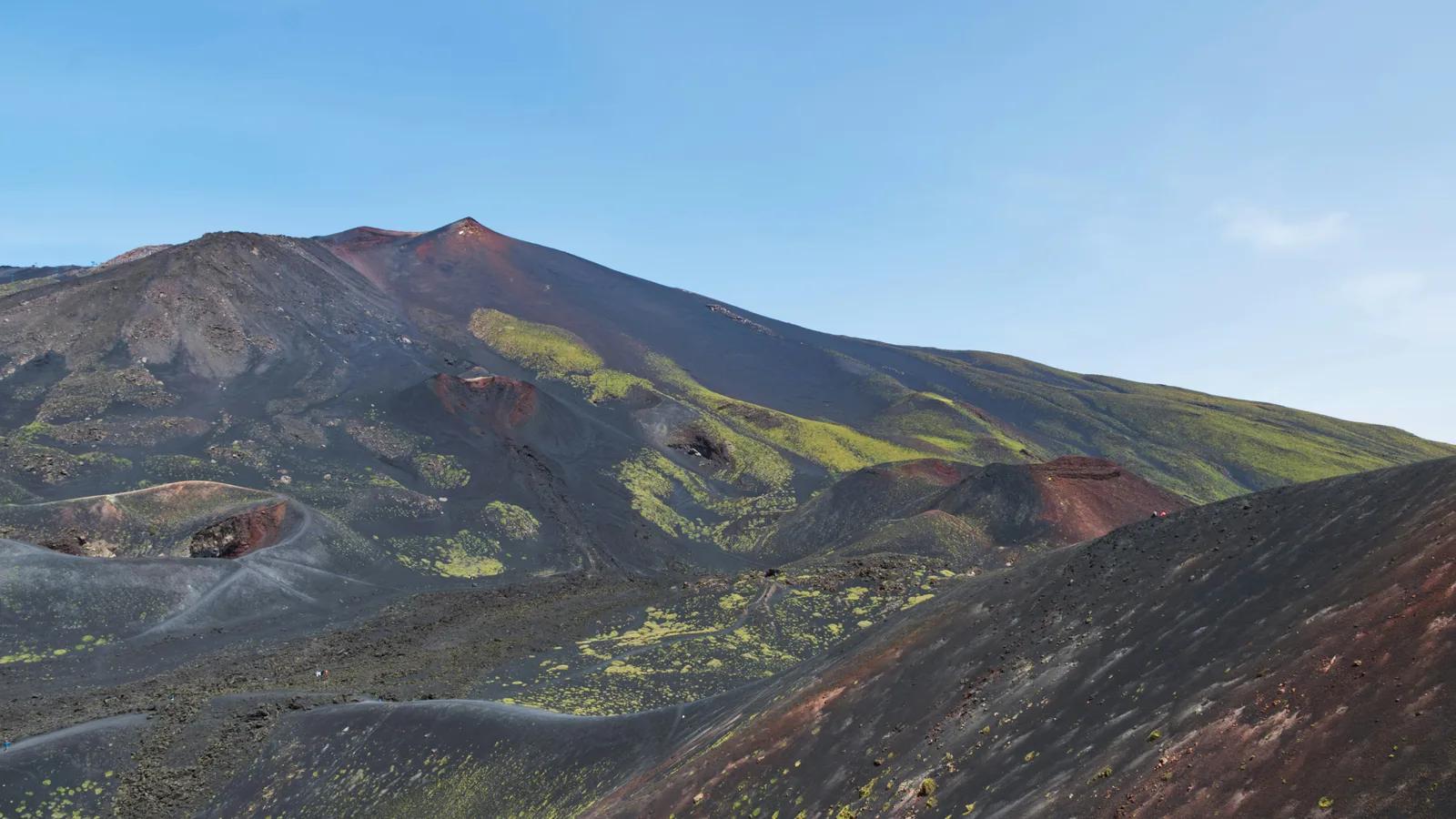
Nine in the morning on the coast below Taormina, and the volcano fills the view to the south-west: one long dark slope rising from the citrus groves by the sea to a summit more than three thousand metres high. In 2013 UNESCO inscribed Mount Etna on the World Heritage List, describing it as the highest mountain of any Mediterranean island and the most active stratovolcano in the world. This day takes you up its south slope with your own chauffeur, from the lava-stone towns of the lower flanks to the craters at nineteen hundred metres and back down again, so that the hairpins, the parking and the timing stop being your concern.
The first stop is Zafferana Etnea, on the eastern flank, a town set on terraces of lava stone and known for its honey. Its Chiesa Madre, Santa Maria della Provvidenza, rises over the square on dark lava steps beneath a white facade. In the long eruption that began in December 1991, a lava flow came down towards the town and stopped, in 1992, less than a kilometre short of it. From Zafferana the SP92 climbs in wide bends, the woods thin out, and the ground turns to black sand and old flows. At about 1,910 metres your chauffeur stops on the forecourt of the Rifugio Sapienza, a refuge that lava has threatened and damaged more than once.
Beside the forecourt rise the Silvestri craters, a row of cones born in the eruption of 1892 and named after the volcanologist Orazio Silvestri. You walk their rims at your own pace, a short walk to the lower crater and a steeper climb to the upper one, while your chauffeur waits at the agreed point. The cable car that climbs towards the Montagnola, at about 2,500 metres, starts here, and off-road vehicles go on higher. Neither is ours. If you want them, you book and pay for them on site, and whether the upper slopes are open on the day depends on the volcano and on the rules of the local authorities. Lunch is yours to choose, for example at the restaurant of the Rifugio Sapienza, and you book and pay for it directly.
On the way down, the SP92 turns south towards Nicolosi through fields of black lava. The flow of 1983 cut this road in many places, and on 14 May 1983 an attempt was made to turn the lava aside with explosives. In July 2001 lava from a fissure at 2,100 metres cut the road once more. Where there is a safe place to stop, your chauffeur pulls in, so that you can see the flows up close. Nicolosi, known as the gateway to Etna, lies below the Monti Rossi, the two red cones of the eruption of 1669, whose lava reached Catania and surrounded the Castello Ursino. The Etna Park authority has its seat here, in the former Benedictine monastery of San Nicolò l'Arena. Then the motorway brings you back along the coast, and you are at your hotel around three o'clock.
The day is private from pickup to return, with no other guests and no fixed schedule: the timings are a shape rather than a timetable, and you adjust them with your chauffeur as you go. If you would like to ride the cable car and spend longer at altitude, tell us when you book, so that the hours fit the day. Etna makes its own weather. At nineteen hundred metres it is cool even in summer, the wind can be strong and cloud can close in quickly, so bring layers, a windproof jacket and closed shoes for the volcanic gravel. We make no promise about the view, the weather or the volcano's activity: we take care of the transport.