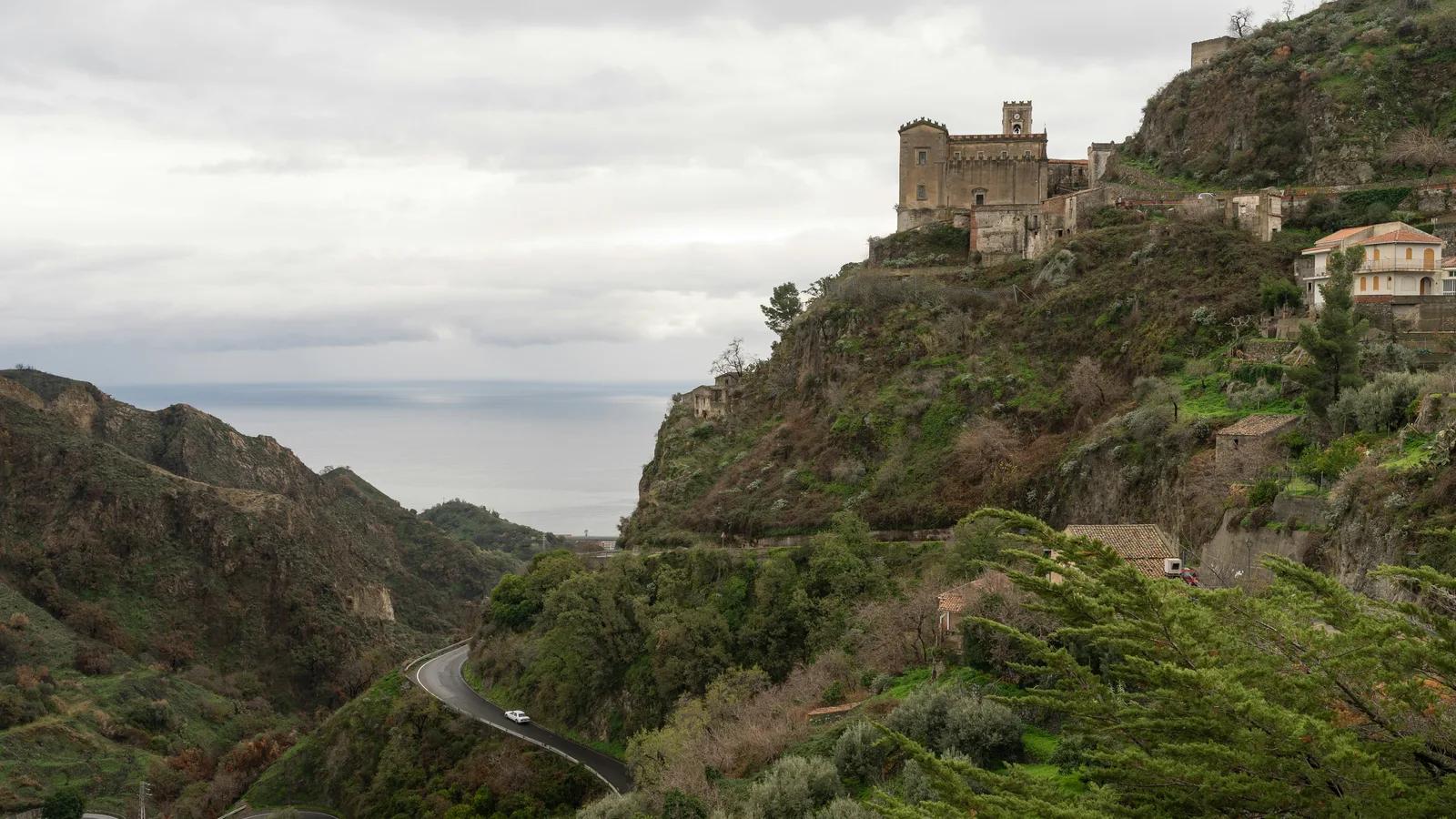
Ten in the morning in Savoca, and the light has already reached Piazza Fossia, at the entrance of a village built across a two-peaked rocky hill some three hundred metres above the Ionian Sea. In 1971 Francis Ford Coppola filmed scenes of The Godfather here and in Forza d'Agrò, the next village down the coast. This private morning with your chauffeur takes in both, and closes in Castelmola, the village on the summit above Taormina, with the coast of Calabria across the water. By distance it is a short day, about sixty kilometres from Taormina and back, but the roads up to the three villages are narrow and full of bends, and that is where a chauffeur makes the difference.
Your chauffeur sets you down at the entrance of the village, and from there you continue on foot. A few steps away, on the ground floor of the eighteenth-century Palazzo Trimarchi, is Bar Vitelli, where Michael Corleone speaks to Apollonia's father in the film. It is still a working bar, and whatever you order there you pay for on the spot. From the bar a lane climbs to the Chiesa di San Nicolò, built in the early thirteenth century on a spur of rock, where the wedding of Michael and Apollonia was filmed. It is often called the church of Santa Lucia, because it keeps the statue of the patron saint of Savoca. The village also keeps its Porta della Città, a pointed arch of local stone through which you enter the old centre. You have about an hour here, on slopes and steps.
From Savoca the road descends to the coast at Santa Teresa di Riva, runs south past Sant'Alessio Siculo and climbs again to Forza d'Agrò, about twenty minutes in all. At 420 metres the village looks across the Bay of Taormina to the profile of Etna. Its Chiesa Madre, dedicated to the Santissima Annunziata, was rebuilt in the early eighteenth century. Coppola chose the village as a location for The Godfather, and in The Godfather Part II it stood in for the Corleone of young Vito. Nearby, a sandstone stair rises to the Arco Durazzesco, a Gothic-Catalan arch of the late fifteenth century that opens onto Piazza della Triade, a natural terrace above the bay, beside the church of the Santissima Trinità. Higher still, for those who want the climb, stands the Castello Argano, which tradition attributes to Count Roger in the eleventh century. You have about forty minutes here, among lanes and steps.
The last climb is to Castelmola, half an hour away on the summit above Taormina, at 529 metres. From Piazza Sant'Antonio, laid out in 1954 with a mosaic floor of white stone and lava stone, Taormina lies below you. A short walk away is the Duomo di San Nicola di Bari, rebuilt in the 1930s, with its terrace facing Etna and the bay of Giardini Naxos, and up the Salita Castello are the ruins of the castle, whose building a tenth-century Greek-Byzantine inscription records. On a clear day the coast of Calabria and the Strait of Messina are in view. From here it is a quarter of an hour down to your hotel, around half past one, or to another address of your choice.
The morning is private from pickup to return, with no other guests and no fixed schedule. The timings are a shape rather than a timetable, and you adjust them with your chauffeur as you go. The lanes of all three villages are narrow, so your chauffeur stops at the entrance of each centre and waits at the agreed point while you walk, a little over two hours on foot across the morning, with slopes and steps everywhere. Bring shoes with grip, and something to cover your shoulders and knees for the churches. If you would like a local expert for the walks, our concierge can put you in touch. You book and pay them directly, and we take care of the transport.