It is half past nine on the Temenite hill in Syracuse, and below you the Greek Theatre opens in a wide curve of steps cut into the living rock. Greeks from Corinth founded the city on the island of Ortigia in the eighth century BC, and Cicero called it the greatest of the Greek cities and the most beautiful of all. UNESCO inscribed Syracuse on the World Heritage List in 2005. This private day with your chauffeur starts in Catania and gives Syracuse the morning, first the Neapolis on the mainland, then Ortigia, where the city began. In the afternoon the road turns south to Baroque Noto.
After about an hour's drive, mostly on the motorway, your chauffeur sets you down at the closest point a car may reach to the Neapolis Archaeological Park, where you buy your own ticket. The theatre was built in the fifth century BC and reworked in the third, and its cavea, about 139 metres across, was one of the largest of the Greek world. The Persians of Aeschylus was staged in Syracuse, and since 1914 Greek plays have returned to the theatre. A path then leads down into the Latomia del Paradiso, an ancient quarry below the theatre, and to the Ear of Dionysius, an artificial cave about 23 metres high that winds some 65 metres into the limestone. Legend says Caravaggio gave it its name in 1608. In 2021 scenes of Indiana Jones and the Dial of Destiny, released in 2023, were filmed in these quarries.
Ortigia, an island joined to the city by bridges, is ten minutes away. Your chauffeur stops at its edge, and from there you walk. The Temple of Apollo, of the sixth century BC, is the oldest Doric temple in stone of Sicily and the Greek West. A few streets on, Piazza Duomo opens around the cathedral, which grew out of a Greek Temple of Athena of the fifth century BC: its Doric columns still stand in the walls, and the Baroque facade went up between 1728 and 1753. Below the piazza, on the seafront, the Fonte Aretusa is a pool of fresh water where papyrus grows, the spring of the nymph Arethusa in the Greek myth. At the tip of the island stands the Castello Maniace, built for Frederick II between 1232 and 1239, which you see from outside: its ramparts frame the siege scenes of the same film. For lunch you pick a table anywhere in Ortigia, booked and paid by you directly.
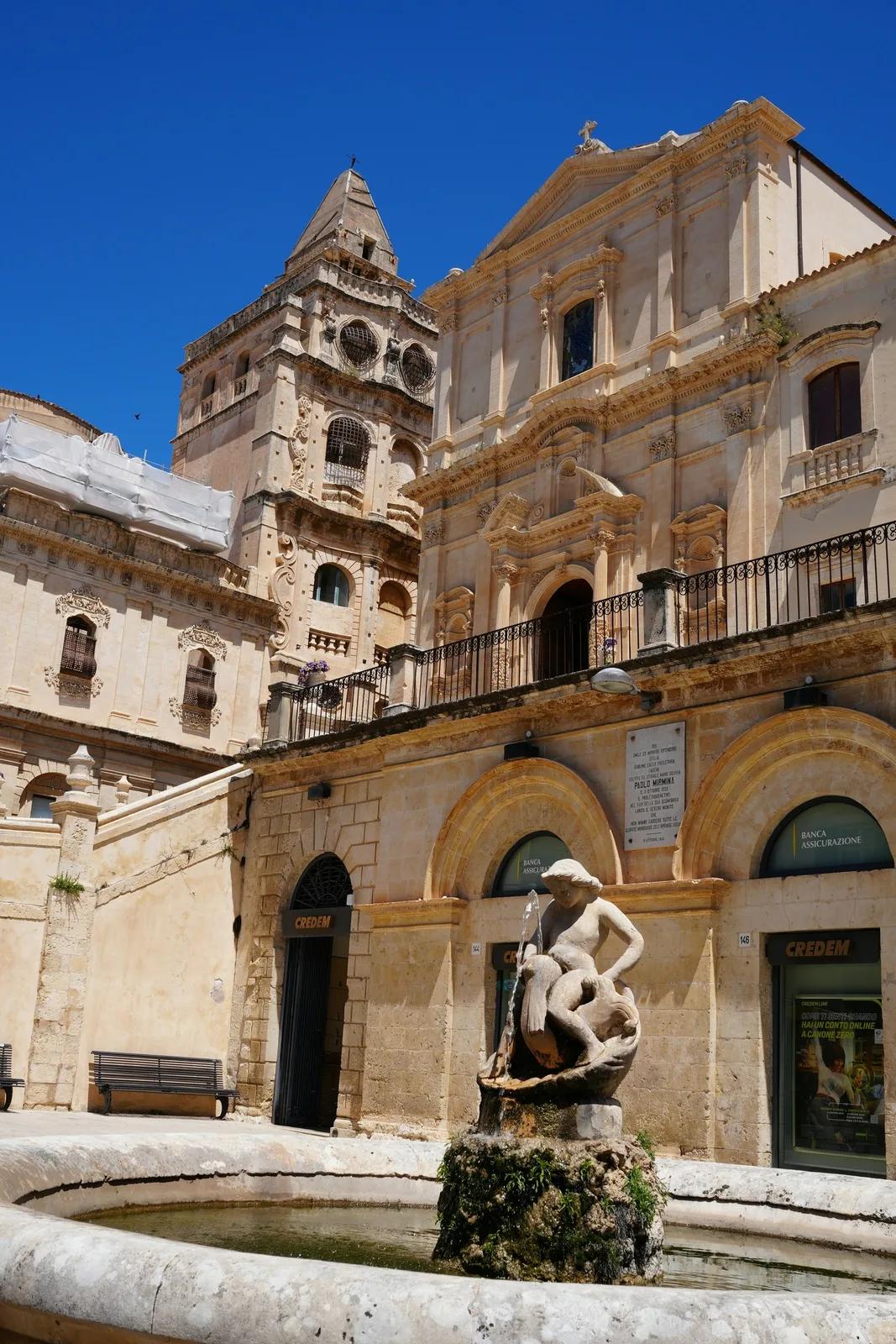
After lunch, about forty minutes on the road past Cassibile and Avola bring you to Noto. The earthquake of 1693 destroyed the old town, and Noto was not rebuilt where it had stood but on a new site. It is one of the eight late Baroque towns of the Val di Noto that UNESCO inscribed in 2002, and Catania, where your day began, is another. You walk in through the Porta Reale, the neoclassical arch of 1838 raised for the visit of King Ferdinand II of Bourbon, and along the Corso Vittorio Emanuele to the staircase of the Cattedrale di San Nicolò, which looks across the street at Palazzo Ducezio. On the evening of 13 March 1996 the cathedral's dome fell, and the church reopened in June 2007. You have about seventy-five minutes in Noto, then about an hour and a quarter back to Catania, where you arrive around a quarter past five.
On paper it is a long day, about 195 kilometres from Catania and back, yet you spend it on foot in three places while your chauffeur drives, parks and waits. No other guests share the vehicle, and the times of the itinerary are a plan you can change: if the theatre holds you longer or lunch runs on, your chauffeur moves the rest of the day with you. You walk a little over four hours in all, so pick shoes that grip and keep shoulders and knees covered for the two cathedrals. Our concierge can also put you in touch with an archaeologist or a local expert for the walks, whom you book and pay directly, while we take care of the transport.