Late morning on the island of Ortigia, where on most days the market stalls of Via De Benedictis run almost to the Temple of Apollo, raised in the sixth century BC and the oldest stone temple of the Doric order in Sicily. Here, in the eighth century BC, settlers from Corinth founded Syracuse, the city Cicero described as the greatest and most beautiful of the Greek cities, and in 2005 it entered the UNESCO World Heritage List. With your own chauffeur, the day leaves the Taormina coast in the morning and gives every hour to Syracuse, with no other town on the way.
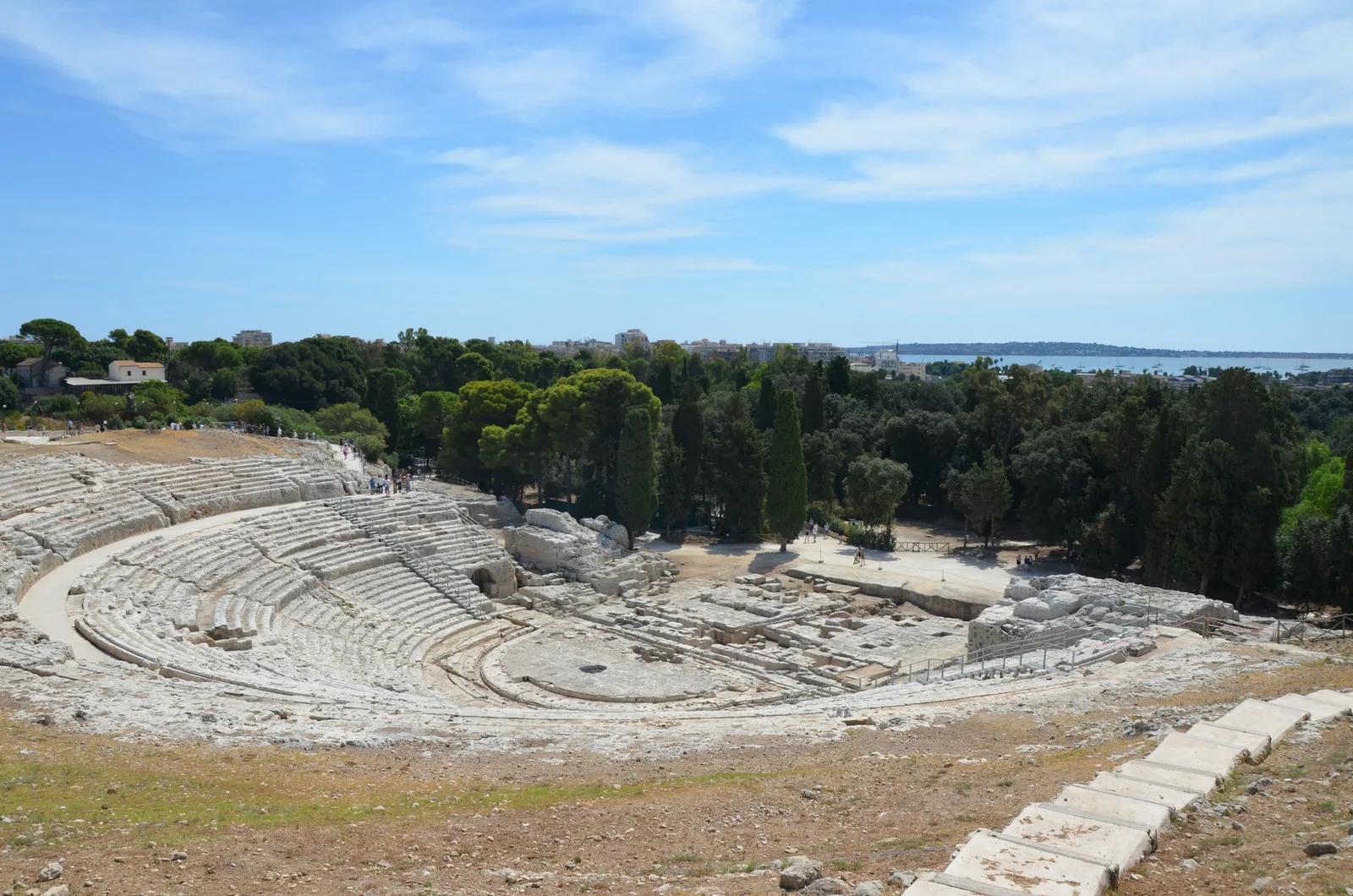
After about an hour and a half on the motorway, past Catania, you are set down at the nearest permitted point to the Neapolis Archaeological Park, buy your ticket on site and spend about two hours there. The Greek Theatre, built on the Temenite hill in the fifth century BC with its steps cut mostly into the living rock, had a cavea some 139 metres across, among the largest in the Greek world. Below it lies the Latomia del Paradiso, one of the ancient quarries of the city: after the defeat of the Athenian expedition in 413 BC, some 7,000 prisoners were held in the quarries of Syracuse. Its best-known cave, the Ear of Dionysius, rises about 23 metres and curves in an S about 65 metres deep into the limestone, and the film Indiana Jones and the Dial of Destiny, shot here in 2021, hides the tomb of Archimedes inside it. On the way back you see, beyond its fence, the rock-cut base of the Altar of Hieron II, about 198 metres long, where the festival of the Eleutheria is said to have included the sacrifice of 450 bulls, then the Roman Amphitheatre, about 140 metres by 119.
Ten minutes by car take you over the bridges to Ortigia. The island is a limited traffic zone at set hours, so your chauffeur stops at the nearest permitted point and you go on foot, first through the market, usually there in the morning from Monday to Saturday, among citrus, vegetables, cheeses and fish. Past the Temple of Apollo, Corso Matteotti leads to the Fountain of Diana, the work of Giulio Moschetti in 1907, where Arethusa turns into a spring at the goddess's feet. Piazza Duomo opens a few streets on: its cathedral was built around a temple to Athena raised in the fifth century BC, whose Doric columns are still part of its walls. Across the square, Palazzo Beneventano del Bosco was rebuilt in 1778 to a design by Luciano Alì, and in the 2025 series The Leopard its facade stands in for the Salinas' palace at Donnafugata. Lunch is yours to choose, and so are the booking and the bill.
After lunch the island narrows towards the sea. Below the seafront wall the Fonte Aretusa holds fresh water and papyrus a few steps from the sea, the spring of the Greek myth of Arethusa and Alpheus, and from there the Lungomare Alfeo follows the water to Castello Maniace, the fortress Frederick II had raised between 1232 and 1239, seen from outside: the same film used its ramparts for the Roman siege of 212 BC, in which Archimedes died. You walk back to the car through the lanes, about twenty-five minutes, and at around half past three your chauffeur takes the road north again, to the Taormina coast at about five in the afternoon or to another address of your choice.
You leave the road, about three hours of motorway in all, to your chauffeur, with the parking and the waiting. The day is yours alone, with no other guests, and the hours in the itinerary give it a shape, not a schedule: stay longer in the theatre or over lunch and your chauffeur adjusts the afternoon around you, and you can add hours when you book. You walk about four and a half hours in all. If you would like an archaeologist or a local expert for the walks, our concierge can put you in touch. You book and pay them directly, and we take care of the transport.